

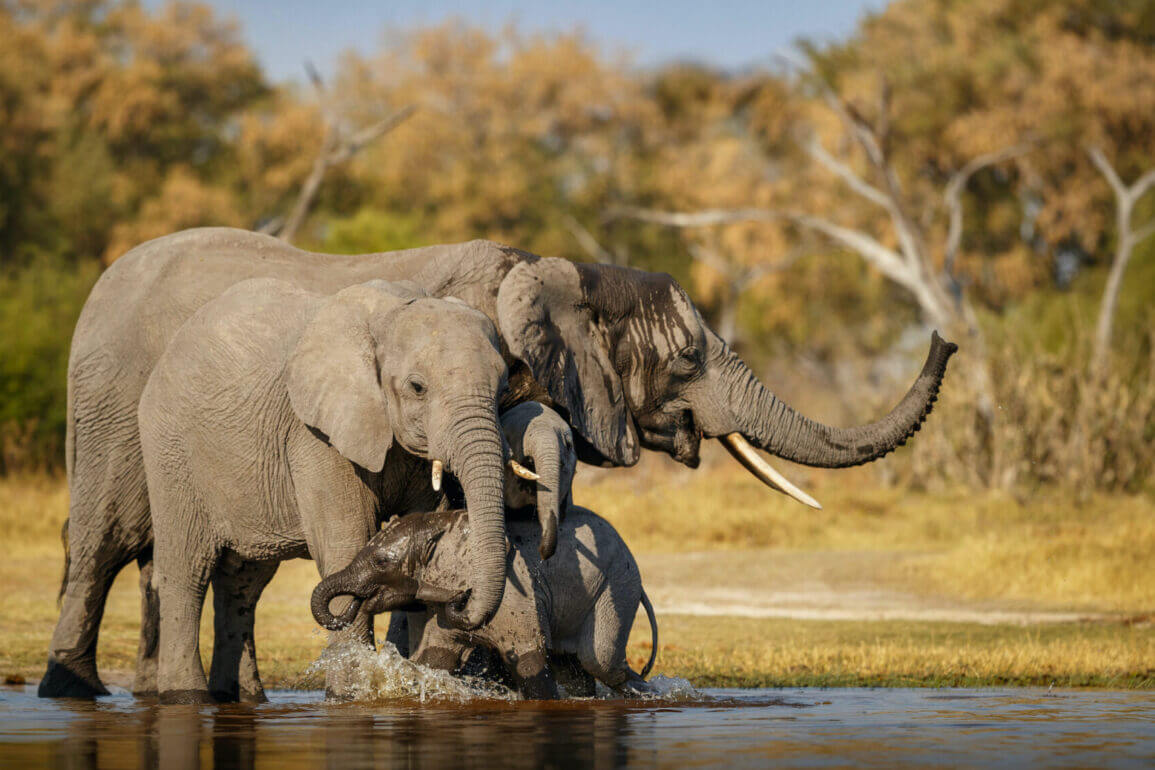
Elephants are one of the most fascinating animals on planet Earth. These gentle giants can weigh up to 7 tons, use their trunk in over 20 different ways, and live for up to 60-70 years in the wild! Elephants are social animals that live and travel in groups known as herds. Today there are only three species of elephant—African Savanna, African Forest, and Asian elephants—but 16 million years ago there were dozens. Did you know, you can look at the size and shape of an elephant’s ears to identify which species they belong to? African elephants have larger ears shaped like the continent of Africa while their Asian counterparts have smaller ears that look similar to the shape of India. Many elephants also have tusks made of ivory, which are really large incisor teeth that grow throughout their lives.
Learn more about elephants—from fossil evidence of their ancient ancestors to future technology inspired by their unique traits—with the videos and activities below.
Jump to article sections:
Learn All About Elephants
Unlikely Animal Relatives | San Diego Zoo Kids
Grades PreK-12
Take a look at three unlikely animal relatives: manatees, elephants, and hyraxes.
African Elephants | Wild Kratts
Grades K-2
Chris and Martin discover Shiva the African elephant, an animal that can weigh up to 7 tons! In this live action segment from Wild Kratts, learn how an elephant can use its trunk in over 20 different ways, from drinking to communicating with their young.
Mud Bath with a Baby Elephant
Grades K-5
Join the Kratt brothers for a ritual mud bath with the elephants! Viewers learn that elephants have as much body heat as thirty people, so mud baths help keep them cool. Discover that elephants use their trunks to spread mud all over their bodies which can help prevent their thick skin from cracking.
Creating Waterholes | The Elephant and the Termite
Grades 3-12
The African elephant and the termite are opposite in size and two very different species of animals. However, together they play an important role in creating waterholes that provide food and shelter for a wide diversity of animal life. Learn how termite mounds become waterholes in video from NATURE’s The Elephant and the Termite.
Age of Elephants
Grades 6-12
Today there are only three species of elephant, but 16 million years ago there were dozens. The evidence comes from Buluk, a site in northern Kenya, where scientists have found an astonishing range of elephant fossils. It was a kind of elephant Jurassic Park, a place one scientist calls the center of the empire of the age of elephants. What happened to all those species? Over many millions of years, due to climate change and predation pressure from humans, elephants waned until today there are only three species left.
Tech Inspired by Elephants
Wild-Inspired Robotic Arms
Grades 6-12
Learn how one company took inspiration from nature to reinvent the robotic arm in this video excerpted from NOVA: “Making Stuff Wilder.” Host and technology columnist David Pogue meets with engineer Heinrich Frontzek to find out about the Bionic Handling Assistant—a machine modeled after an elephant’s trunk.
Genetic Engineering to Prevent Extinctions | NOVA Wonders: Can We Make Life?
Grades 9-12
Learn how genetic engineering could be used to prevent extinctions, in this video from NOVA Wonders: Can We Make Life? The Asian elephant is endangered and on the brink of extinction; however, genetic engineering could help conserve the species. George Church is an innovator of genetic technologies and is investigating how to combine the DNA of the extinct woolly mammoth with the DNA of the Asian elephant to make a “winterized” Asian elephant that could survive in the Arctic tundra.
Activities, Games & More
Let’s Share a Story: “Strictly No Elephants” | Let’s Learn
Grades PreK-K
In this Let’s Learn video, literacy coach Amanda Gino reads the picture book Strictly No Elephants, by Lisa Mantchev, about a boy and his pet elephant.
Planning an Elephant’s Party Digital Game | Martha Speaks
Grades K-5
Party planning for an elephant involves some hard work with Martha Speaks. This interactive story focuses on comparing and estimating measurements and nonstandard units of measurement. After the story, children can answer review questions in the interactive quiz.
Man versus Elephant! Interactive Lesson
Grades 3-5
Read like a detective and solve a BIG problem on the island of Sumatra where man and Asian elephants struggle to live together and get along! This self-paced lesson is interesting for all ages (and the BIG solution at the end may surprise you.)
Comparing and Contrasting – Grassland, Desert, and Forest Elephants
Grades 6-8
Watch three video segments about three different types of elephants to identify the similarities and differences among them. While viewing the segments, take notes using a T-chart. With partners, categorize and organize your notes and then construct a poster-size Venn diagram comparing and contrasting each elephants’ characteristics.
Survey Methods Digital Interactive
Grades 6-12
In this interactive, students explore the methods scientists use to survey elephants and learn about the current state of the elephant population in Africa. This HHMI BioInteractive expands on the coverage of the Great Elephant Census in NATURE: “Naledi: One Little Elephant.” The story of African elephants is a powerful case study of how science can inform conservation. It is important to track how many elephants are left and where they live to help protect them.