

This article is reposted from the original with permission from NCPR.
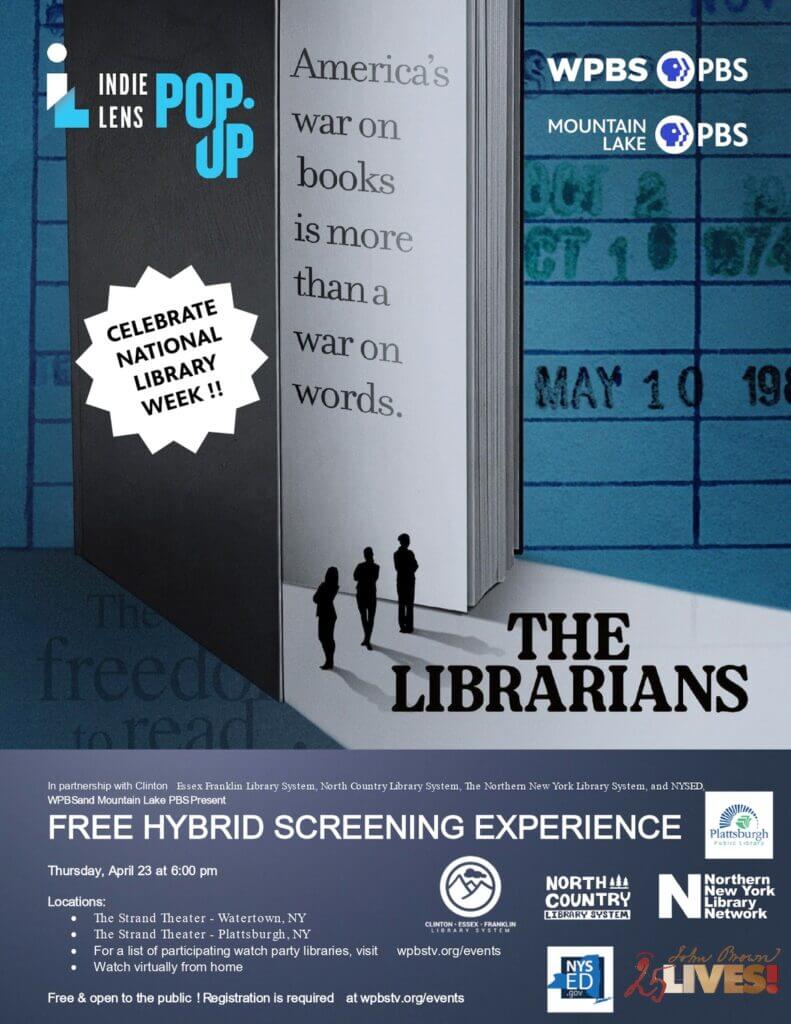
It’s National Library Week! Here in the North Country, Mountain Lake PBS in Plattsburgh and WPBS in Watertown are partnering with the Clinton-Essex-Franklin Library System, the North Country Library System, the Northern New York Library System, John Brown Lives!, and the NYS Education Department to present screenings of the documentary “The Librarians.”

The events will take place on Thursday at 6 p.m. at The Strand theaters in Plattsburgh and Watertown, and feature panels after the film. Local libraries across the region will host simultaneous watch parties. Click here for the full list.
“The Librarians” follows the school and public librarians fighting back against a coordinated effort across the country to ban books focused on race and LGBTQ-plus stories.
Director Kim A. Snyder told NCPR Champlain Valley reporter Cara Chapman that the stakes are high for these librarians. She says they know that books have the power to save kids’ lives. Their conversation has been lightly edited for clarity.
Listen to Director Kim Snyder’s interview with Cara Chapman
KIM A. SNYDER: It was very poignant to understand that, above all things, especially school libraries at that more tender age, how important it was to the librarians to say things like, “They’ll have to take me out in handcuffs before I betray that child by removing books.” I think it’s not lost on any kid that feels other for any reason—because they’re queer, because they’re black, because they’re marginalized for any number of reasons—that when they tell you they want to take books with characters that are representational of you and your identity off the shelf, it means they don’t want you on the shelf. They don’t want you amongst them. And that is a really chilling thing that we’ve seen happen in very dark times in our world history.
CARA CHAPMAN: What are you trying to say to those kids in the face of that?
SNYDER: We have had the opportunity to show the film to high schoolers who’ve reacted in a very engaged way with a lot of emotion. I think it’s not only that they’ve stood up and said, “Thank you,” with real gratitude for understanding how important this issue is for them. They have so many things to worry about—the climate and guns. But I think in some ways, what I like to think is that there’s a depiction of adults who actually are acting with a sense of integrity in a time when so much of the leadership they can look at is not that. I think that there’s a real craving and these kids understand that these are people who are finally showing authenticity and moral conviction.
CHAPMAN: We’re in a rural area. We’re about to have screenings of “The Librarians” in New York’s North Country. How has this film been received in rural areas and has that differed at all from when you’ve screened it in more suburban or urban areas?
SNYDER: Honestly, we’ve shown in over 200 independent movie theaters about the country. I would say some of our most robust and sold out screenings have been in the Heartland, in more rural parts of America. I’m proud that we made a film that seems to engage, but I think it’s larger than that. I think it’s telling us something, that this is striking a nerve. It’s cutting across partisan lines and it’s drawing in people of faith who really understand that this is dangerous. These are the kinds of things that we saw take hold in communist Europe and any number of places. I think that a lot of Americans are just really attached to the preciousness of our public education, to the importance of our libraries and protecting our libraries. And now, I think with raising awareness about this attack on our librarians, they’re really understanding that we need to not have the librarians landing in an isolated, unfathomable place where they’re actually being threatened at times with criminalization, firing, the kinds of things we see in the film.
CARA CHAPMAN: In the more than a year since the film was initially released, what’s happened with both the coordinated campaign to implement these book bans and the fight against them? Where do you think stand in the current moment?
KIM SNYDER: We’re standing on a precipice where, on one hand, the film is an alarm bell and has a dystopian message of, “The train’s in the station. This is not good.” But on the other hand, we’re seeing a lot of heartening signs just by virtue of how many people have reacted to this movie. We have shown it in places where we know that we have affected school board races. We haven’t endorsed anyone, but we’ve encouraged people to show up and try to get people who are pro-public education and fighting for our libraries to be preserved in those seats. There are a lot of signs that the vast majority of Americans really care about this. They care about censorship and the freedom to read and they are showing up to say, “How can we get involved?” Lastly, we’ve learned that the film is also resounding really strongly abroad. This is happening in Rome and Zurich and they say things that these screenings like, “When you sneeze, we catch cold.” So we know that this is part of a movement of, I think, more dangerous, very right-wing forces that are not just here in this country. And people are understanding the story as not just an American story.
CARA CHAPMAN: What do you hope is next? What do you want people to carry with them and carry forward after they see the film?
KIM SNYDER: We know that this is a critical year. And again, not in a partisan way, but we believe it’s essential that people become civically engaged in their hyperlocal, down-ballot races and to show up, because this is where they can have agency, like in school board elections and library boards. This is what determines the policies of important things around your local public education and around keeping censorship from creeping in. That’s what we’re asking people to do is to really become involved and become more educated about what’s happening in your own location and to get to know what’s happening in your library, your library board, maybe run for those seats and get to know your local librarian so they don’t feel alone in situations that we see some of our librarians end up in.